

Let me ask you something, ladies.
If I asked you right now how much you spent on food last month, could you tell me? Not a guess. The real number.
If you hesitated, you are in very good company. Most of the smart, driven, hardworking women I meet can tell me exactly what their paycheque is. Very few can tell me exactly where it went.
And here is what I want you to hear: that is not a character flaw. It is simply missing information.
The good news? Information is fixable. And it is the very first step of every solid financial plan I have ever built.
Why Knowing Your Numbers Comes Before Everything Else
I have worked with hundreds of women over the years, and the conversation almost always starts the same way. They want to invest. They want to buy a home. They want to fund their kids’ education, retire comfortably, build something that outlasts them.
All of those are powerful goals. But every one of them depends on one quiet question:
How much money do you actually have available to work with?
You cannot invest what you cannot find. You cannot save toward a goal if your money disappears before you assign it a job. A budget is not about restriction. It is about clarity. It is the foundation the whole house sits on, and no one gets excited about a foundation, but nothing stands without one.
When you know your numbers, three things change:
You stop feeling anxious about money. Fear loves a blank space. Once you fill it with facts, the fear loses its grip.
You make decisions with confidence. “Can I afford this?” stops being a gut feeling and becomes a clear yes or no.
You can finally build. Savings, investments, debt payoff and legacy planning all start from a real number, not a hopeful one.
The Money Leaks We Don’t See
Here is the thing about spending. The big things, like rent, mortgage, childcare and the car payment, are easy to track. We know about those.
It is the small, steady leaks that quietly drain us:
The subscriptions you forgot you signed up for
The “quick” coffee and grocery runs that happen four times a week
Food delivery on the nights you were too tired to cook
Online shopping at 11pm
The “treat yourself” moments that add up to a vacation’s worth over a year

None of these are bad on their own. You work hard, and you deserve joy. The goal is never to cut out every pleasure. The goal is to spend on purpose, so your money reflects what truly matters to you.
You can only do that when you can see it.
A Simple, Judgment-Free Way to Find Your Numbers
You do not need a finance degree or a complicated spreadsheet. Here is the process I walk women through. Give yourself one hour and a cup of something warm.
Step 1: Start with your real income
Write down what actually lands in your account each month after tax. If your income changes from month to month, use your lowest recent month as your baseline. It keeps your plan realistic and protects you from surprises.
Step 2: List your fixed expenses
These are the bills that stay mostly the same: housing, utilities, phone, insurance, loan payments, childcare. Easy to find, so start here for a quick win.
Step 3: Track your variable spending for 30 days
This is the step that changes everything. Groceries, gas, dining out, shopping, entertainment, personal care. For one full month, write down every single thing you spend. Every coffee. Every app charge. Every “it was only $12.”
Do not judge it. Do not fix it yet. Just notice.
Step 4: Look for patterns, not problems
At the end of the month, add it up and group it into categories. You will likely feel one of two things: surprise or relief. Both are useful. Ask yourself:
Where did more money go than I expected?
Does my spending line up with what I say I value?
What is one small shift that would free up cash for my goals?
Step 5: Give every dollar a job

Now you can build your plan. A simple starting framework many women find helpful is:
Needs (the essentials that keep your life running)
Wants (the things that make life enjoyable)
Future you (savings, investing, debt payoff)
The exact percentages depend on your life, income and goals. What matters is that future you gets paid on purpose, not with whatever is left over at the end of the month. Spoiler: there is rarely anything left over.
Why Consistency Beats Perfection
I will be honest with you. Most people do not fail at budgeting because it is too hard. They fail because they try to do it perfectly, miss a few days, feel guilty, and quit.
Please hear me: a budget you actually use will always beat a perfect budget you abandoned.
That is why I believe in building the habit in a structured, bite-sized way. Ninety days is long enough to form a real habit and see real patterns, and short enough to feel doable. Three months of paying attention can change the way you relate to money for the rest of your life.
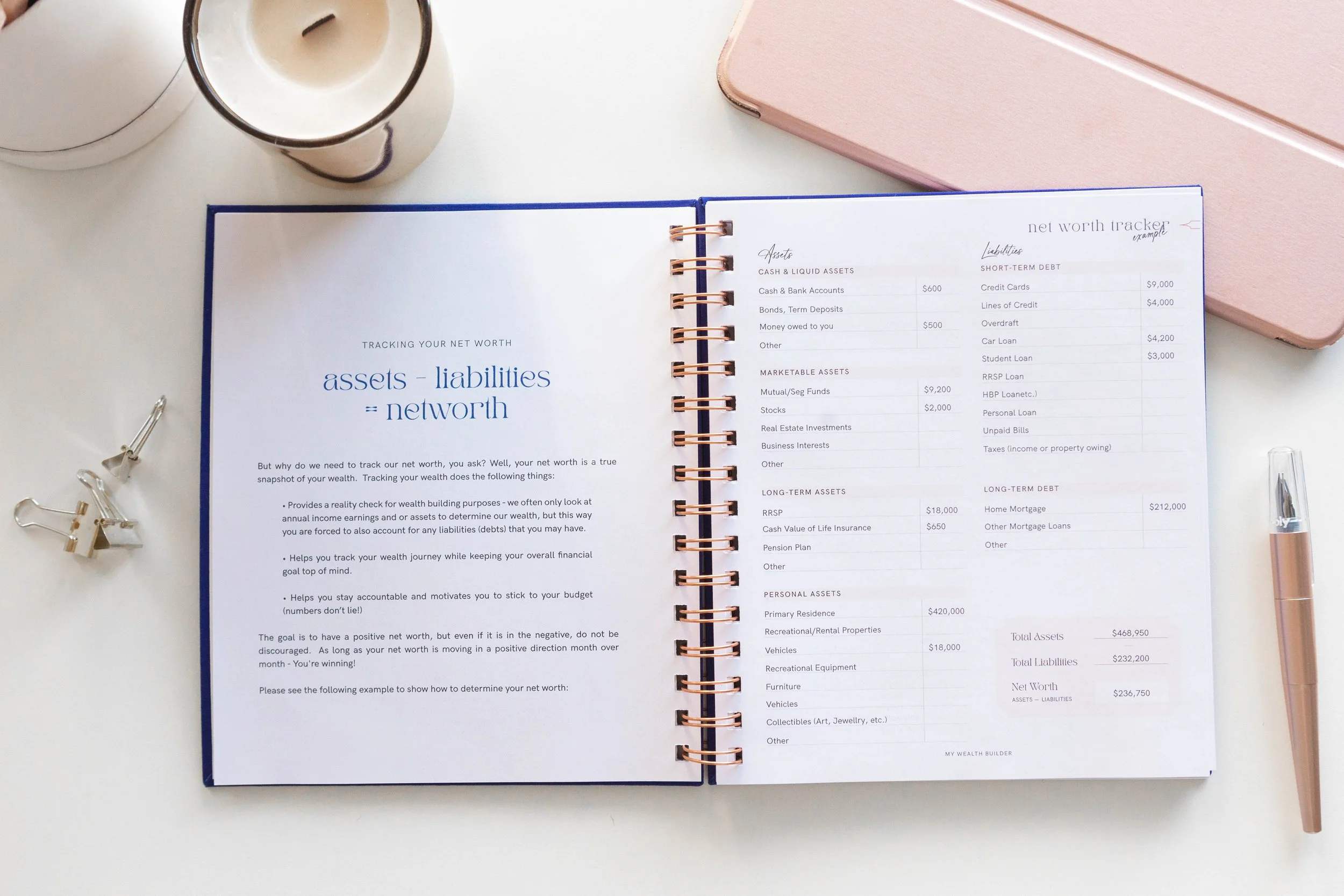
This Is Exactly Why I Created the My Wealth Builder Planner
I created the My Wealth Builder Planner because so many women told me the same thing: “I know I should be tracking my money, I just don’t know where to start.”
It is a 90-day financial planner designed for women who are ready to take control of their money and build a strong foundation, especially if you are earning under $100K and not quite ready for a full financial planning relationship yet. Think of it as having a financial coach in your corner, on paper.
Here is what is inside:
A financial goal focus. Before you track a single dollar, you get clear on what you are building toward. Your numbers mean more when they are tied to a why.
A monthly budget. A clear, easy layout to map your income, your fixed costs and your priorities, so every dollar has a job.
A daily spending log. The 30-day awareness exercise I described above, built right in. A few quick minutes a day shows you exactly where your money is going.
Weekly money mantras. Because money is emotional as much as it is mathematical. Each week gives you a mindset reset to quiet the old stories and replace them with confident, empowered ones.
A feminine, stylish design. Because this is something you will want to open, not avoid. Budgeting does not have to feel boring or heavy. It can be beautiful.
It is $38 (CAD), and I designed it to be the first step toward the kind of financial clarity that compounds over a lifetime. Honestly, one forgotten subscription found in your first week could pay for it.
What Happens After 90 Days
By the end of your 90 days, you will not be guessing anymore. You will know:
Exactly what you earn and exactly what you spend
Which habits are serving you and which are not
How much you can confidently direct toward savings, debt payoff and investing
What your next financial move should be
That clarity is the launchpad. From there, whether you keep building on your own or you are ready to sit down for a full financial plan, you are walking in prepared, confident and in control. 💫
Your First Money Move Starts Today
You do not need to wait for January, a raise, or the “right time.” The women who build lasting wealth are not the ones who earn the most. They are the ones who know their numbers and act on them.
So here is my challenge to you this week:
Pull up your last 30 days of transactions.
Pick your top three spending categories.
Ask yourself honestly, “Does this reflect what I truly value?”
That is it. That is a money move. 🙌🏾
And when you are ready to turn that awareness into a real plan, the My Wealth Builder Planner is here to guide you, one day at a time, for the next 90 days.
